 Leeja Miller
The White House announced a ban on three major news organizations from participating in the White House press pool, including CNN, MSNOW, formerly MSNBC, and Politico. Members from these news organizations who attempted to enter their offices at the White House were turned away and told their credentials had been revoked. The White House issued a press release claiming the First Amendment protects their right to publish, but the ban was seen as a restriction on their access to the press pool. Members of the press filed a lawsuit to address these issues, sparking discussions about the First Amendment and the relationship between U.S. presidents and the press. This latest ban by President Trump reveals shades of authoritarian intent, as he continues to restrict media access and control the narrative.
The lawsuit filed by CNN, MSNOW, and Politico against Trump and his administration argues that Trump's ban on the press is a violation of the First Amendment. They claim that Trump, as a government actor, is discriminating against the press based on their viewpoints, which is a violation of viewpoint discrimination. The lawsuit uses Trump's own words against him, including his use of the term 'fake news' to describe the press, to support their argument. This lawsuit highlights the central claim of viewpoint discrimination, where a government actor must control someone's speech in a viewpoint-neutral and reasonable manner, unlike Trump's actions that clearly target the press based on their viewpoints, as evidenced by his repeated use of the term 'fake news'.
The news organizations argue that Trump's ban on press passes violates their First Amendment rights, including uninhibited debate on public issues, robust and wide open criticism of government and public officials, and retaliation against journalists for their protected speech. They also claim violations of the Fifth Amendment due process rights, as the ban was implemented without prior notice and an opportunity to be heard. The news organizations are represented by the same lawyer who represented Jim Acosta in a similar case during Trump's first term. The Trump regime sent out notice letters to the three news organizations, giving reasons for the revocation of their passes, citing reporting incidents that threatened national security and spread lies. However, these reasons are not supported by the law, and the Trump regime's actions are seen as an attempt to cover their legal shortcomings by invoking national security concerns.
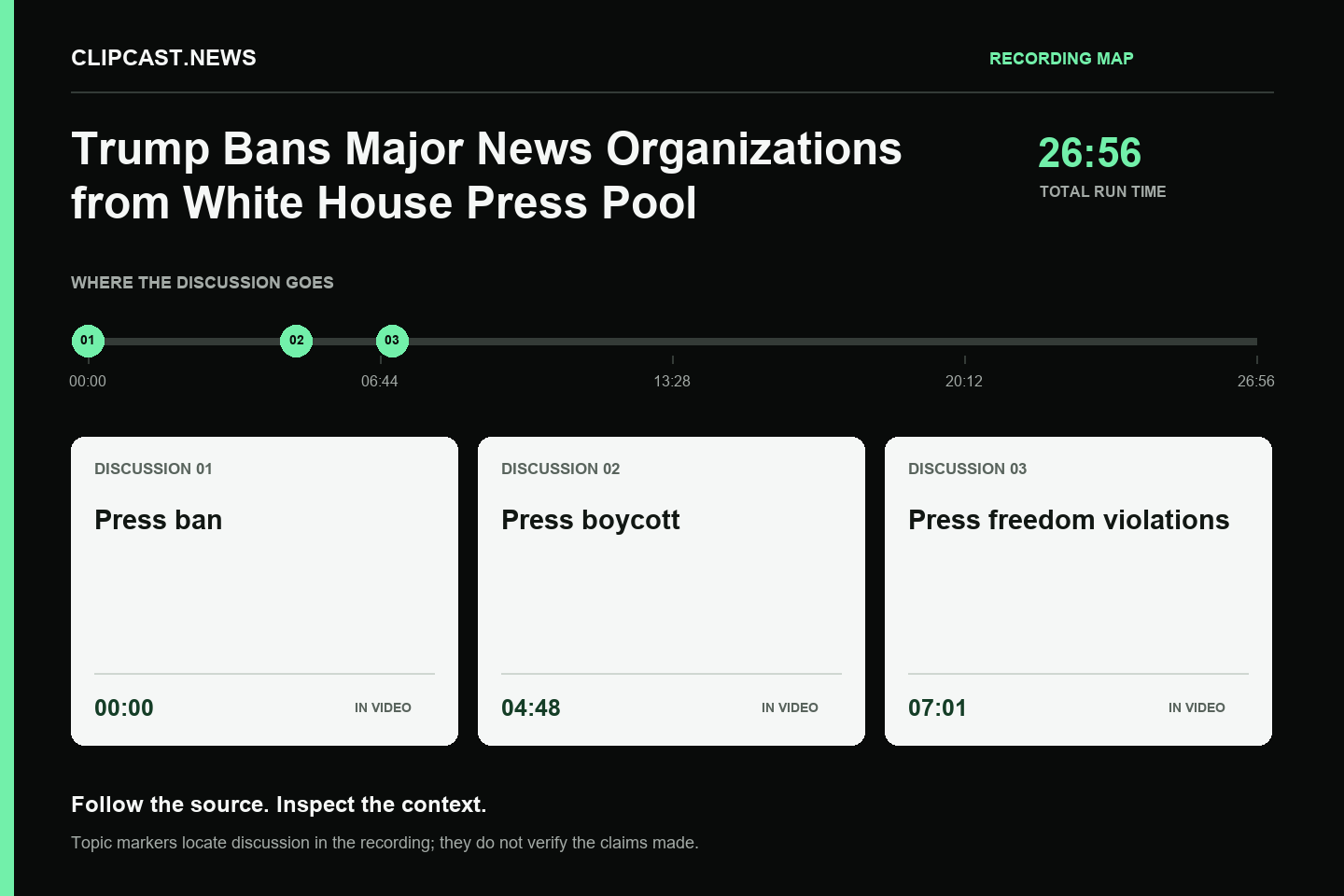
The recent ban of major news organizations from the White House by President Trump has sparked a heated debate about press freedoms in the United States. Critics argue that the president's actions restrict journalists' access to vital information, potentially undermining the constitutional right to a free press. The incident has underscored the importance of press freedoms and the potential for abuse of executive power. Despite legal precedents, the Supreme Court's recent decision in favor of the Associated Press reinstating its press passes has set a precedent that could be used to justify future restrictions on media access. However, the current composition of the DC Court of Appeals, with only three Trump-appointed judges out of eleven, leaves the outcome of any potential appeals uncertain. Meanwhile, the ban has already caused immediate harm to the livelihoods of news organizations and their reporters, who are denied access to crucial information during critical moments such as the UN General Assembly and meetings with world leaders. The controversy has led to an urgent call for an emergency injunction to reinstate press passes and allow journalists to continue their vital work.
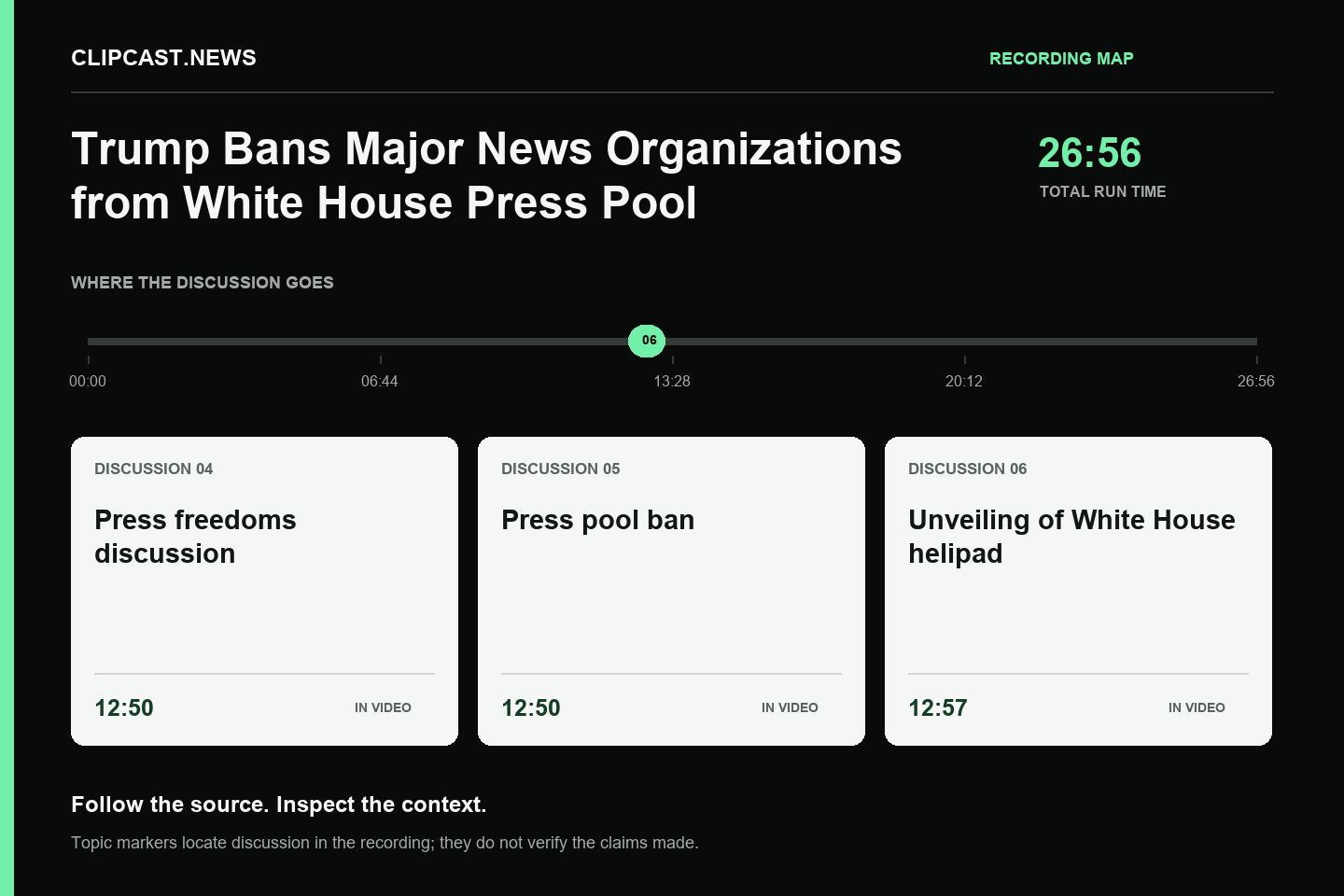
Trump has banned CNN and other major news organizations from the White House, including the official press pool, which has a rotation of five media organizations. This ban has affected the ability of these organizations to gather and disseminate news, creating an immediate and ongoing injury to their livelihoods and the livelihoods of their reporters. The ban has also led to a discussion about press freedoms in the United States. The government submitted their argument to the court as to why they shouldn't be enjoined from banning these news organizations, claiming that the journalists failed to maintain basic minimum standards of professionalism and decorum by publishing sensitive or classified information. They argue that they did give them due process, but ignore the fact that it was literally given a couple hours ago. They also argue that the Associated Press, which was banned for refusing to call the Gulf of Mexico the Gulf of America, had a good legal argument, so instead they're arguing that it's just a bad decision should be overruled. There is one area where the law is on their side, and that is at the appellate stage. Despite decades of precedent, a case last year in which the Associated Press sued Trump after he banned them from the White House for their refusal to call the Gulf of Mexico, the Gulf of America, resulted in the DC Circuit reinstating AP's press passes, and then the DC appellate court stayed that preliminary injunction, meaning they let Trump's AP band stand everywhere except the East Room, which the two Trump appointees on the appellate court reasoned was the only place that was constitutionally protected under the First Amendment as a public forum for journalists to enter. Everywhere else, the Oval Office, Air Force One, Mar-a-Lago, wasn't protected under the First Amendment so that President has the discretion to decide who could be there. And that's the power of having judicial appointees willing to place the supremacy of the president over longstanding legal precedent and the rights of the people to have access to information. Meanwhile, the original complaint alleges that the president is doing incredibly consequential things this week, going to the UN General Assembly, meeting with a major world leader, leading a country that is actively at war and navigating a dismal AI landscape. All the while, these major news organizations are being barred from accessing him and that information, creating an immediate and ongoing injury to the livelihoods of these news organizations and their reporters. In light of the immediate harms being caused, the parties requested an emergency hearing to ask the judge to issue an emergency injunction to force the president to reinstate their press passes and their presence inside the White House. The ban has ignited a really important discussion about press freedoms in the United States. On Monday, Trump held a ceremony to unveil the new White House helipad, as you saw in the intro. The reason why you couldn't hear anything he said is because the press is usually there to set up the sound equipment. CNN was banned on Friday, and it was their turn to manage the press pool news gathering on Monday. In solidarity with their colleagues at CNN, and MSNOW, and Politico, the other four main news organizations, the ban has affected the ability of these organizations to gather and disseminate news, creating an immediate and ongoing injury to their livelihoods and the livelihoods of their reporters. CNN was banned on Friday, and it was their turn to manage the press pool news gathering on Monday.
Trump unveiled the new White House helipad on Monday, an event that was not attended by the press due to a ban. The press usually sets up sound equipment for the president's speeches, but this ban has prevented them from gathering and disseminating information about the president's activities, causing immediate and ongoing harm to their livelihoods. The ban is seen as a violation of press freedoms in the United States, as the helipad unveiling was a public event where the press typically plays a crucial role in news gathering and dissemination. CNN, one of the five major media organizations that usually manage the press pool, was also banned from the event, further highlighting the impact of this restriction on the news industry.
Media companies agreed not to cover White House events and photos of President Trump's activities until reinstated, in response to his actions against the press, such as denying them access to information, harassing journalists, and targeting them with subpoenas and searches and seizures. This boycott was seen as a violation of the press's rights and the First Amendment. The press's right to access information and hold the government accountable was being violated, making the actions of the president unconstitutional and a violation of our rights. However, the boycott also ignited a conversation about the necessity of 24-7 access to the president on White House grounds for the people to have access to information, questioning whether reporters on the plane with the president were truly increasing access to information and improving democracy. Instead, they were providing fuel to the fire of a megalomaniac president who could do and say whatever he wanted, knowing the press would treat it like breaking news coming to you live from inside the White House. The press didn't need to be present for me to know that Trump unveiled a helipad on Monday, but they can still do their fact-finding and hold the president to account without giving Trump the opportunity to give soundbite after soundbite whenever he wants.
The speaker emphasizes the importance of press freedoms and the need to hold the administration accountable. They highlight the unusual levels of abuse Trump is lobbying for the press, including unprecedented all-out bans on certain news outlets from White House press coverage. The speaker also points out the power of press pool boycotts and the impact of press coverage on public knowledge and democracy. They argue that the constant 24-hour news cycle, which benefits the regime, is not contributing to public knowledge and democracy, and that press freedoms are essential for holding the administration to account and not normalizing the behavior of the regime.
The power of press pool boycotts was immediately apparent during recent events, as seen when Trump spoke into the wind with no media presence. This stark contrast highlighted the importance of press freedoms, accountability, and the need to not normalize the behavior of this administration, which has proven itself to be habitual liars to the detriment of the Republic. The boycotts send a powerful message, emphasizing the importance of holding the administration to account and not giving oxygen to those who have abused press freedoms for a decade. Unlike past instances where presidents have selectively excluded certain media outlets, Trump's current actions are unprecedented and abnormal, necessitating continued discussion to prevent them from becoming the new normal in the US. Additionally, the White House's unveiling of Trump TV, a constant live stream of clips, underscores the president's strategy to control the narrative and create polished propaganda. These actions demonstrate the value of skilled journalists and media presence at official visits and cabinet meetings, which can increase control over the narrative and contribute to public knowledge and democracy.
The speaker emphasizes the power of press coverage in holding the administration accountable and increasing public knowledge. They highlight the unprecedented levels of abuse Trump is lobbying for against the press, including bans on certain news outlets from White House press coverage. The speaker also notes the importance of press presence at official visits and cabinet meetings, stating that it is essential for information gathering. However, they argue that the constant 24-hour news cycle, which benefits the regime, is not contributing to public knowledge and democracy. The speaker points out the power of press freedoms, holding the administration to account, and not normalizing the behavior of the regime. They also mention the unusual levels of abuse Trump is lobbying for, such as the unprecedented all-out bans on certain news outlets from White House press coverage. The speaker concludes by stressing the importance of continuing to discuss how abnormal these actions are to prevent them from becoming the new normal in the US. They also discuss how the White House official YouTube channel unveiled Trump TV, a constant live stream of various clips of Trump content, as a means of creating polished propaganda and increasing control over the narrative.
The relationship between the government and the press is adversarial by design, with the mainstream media still pivotal in news gathering and creating sound bites and clips for social media. However, the mainstream media is increasingly captured by elites sympathetic to white nationalist, capitalist, and populist views, aligning with the authoritarian regime's interests. Scholar Ruth Ben-Gaet discusses the propaganda process of noise and silence, noting that increased media capture by these elites accompanies press bands. The merger between Paramount Skydance and Warner Bros Discovery is described as a consolidation of the media landscape into the hands of a billionaire family aligned with Trump, potentially devastating for democratic destruction. Ben-Gaet points to Viktor Orbán's media capture in Hungary, where 85% of media was aligned with his regime, and suggests that bypassing media capture through grassroots efforts can be effective in defeating authoritarian regimes.
The history of authoritarian regimes, exemplified by Nazi Germany, underscores the importance of a robust propaganda apparatus to suppress the press and consolidate power. Nazi propaganda ministry controlled the Reich Association of the German Press, regulated journalists, and censored information. This control was achieved by outflanking political parties and seizing the printing plans of newpapers, leading to the regulation of who could be a journalist and the establishment of mandates under the editor's law of October 1933. Journalists were ordered to censor anything calculated to weaken the Reich's strength abroad or at home, and political opponents and non-compliant journalists were rounded up and sent to concentration camps. In the present, parallels are drawn between past authoritarian regimes and current events, such as Trump's intimidation of journalists, to emphasize the need for vigilance and action to prevent full authoritarian capture of the press. The speaker highlights the central role of the mainstream media in holding regimes accountable, noting their strength in numbers and collective boycott power, which must be leveraged for real accountability.