Treasury Yields and Financial Risks: The Recorded Analysis Explained
The recording discusses the sharp rise in Treasury yields, linking it to financial instability and historical precedents of economic disruption. It also raises concerns about global food shortages, potential nuclear conflict, and the AI bubble burst as factors that could lead to a severe economic collapse.
Published September 26, 2026 · Updated September 26, 2026
The cited sources give this account: The 10-year Treasury bond yield has surged to levels not seen since 2004, with the 30-year Treasury note reaching 5.444% and the 10-year nearing 5.15%. This rise is linked to the inverse relationship between bond prices and yields, where falling bond prices push yields higher. Analysts warn that such rapid increases in yields have historically preceded financial disruptions.
Experts suggest that the spike in Treasury yields is a baseline for borrowing costs, affecting credit card rates, loan rates, and mortgage rates. The analyst mentioned in the recording noted that in the last five decades, 16 instances of rapid yield increases were followed by financial calamities, ranging from the 1987 stock market crash to the 2023 Silicon Valley Bank failure.
The rise in yields is also tied to inflation and the Federal Reserve's interest rate hikes, which are intended to curb inflation but can exacerbate borrowing costs. The recording highlights that the 10-year Treasury yield is a critical indicator of economic health, with its fluctuations signaling potential economic downturns.
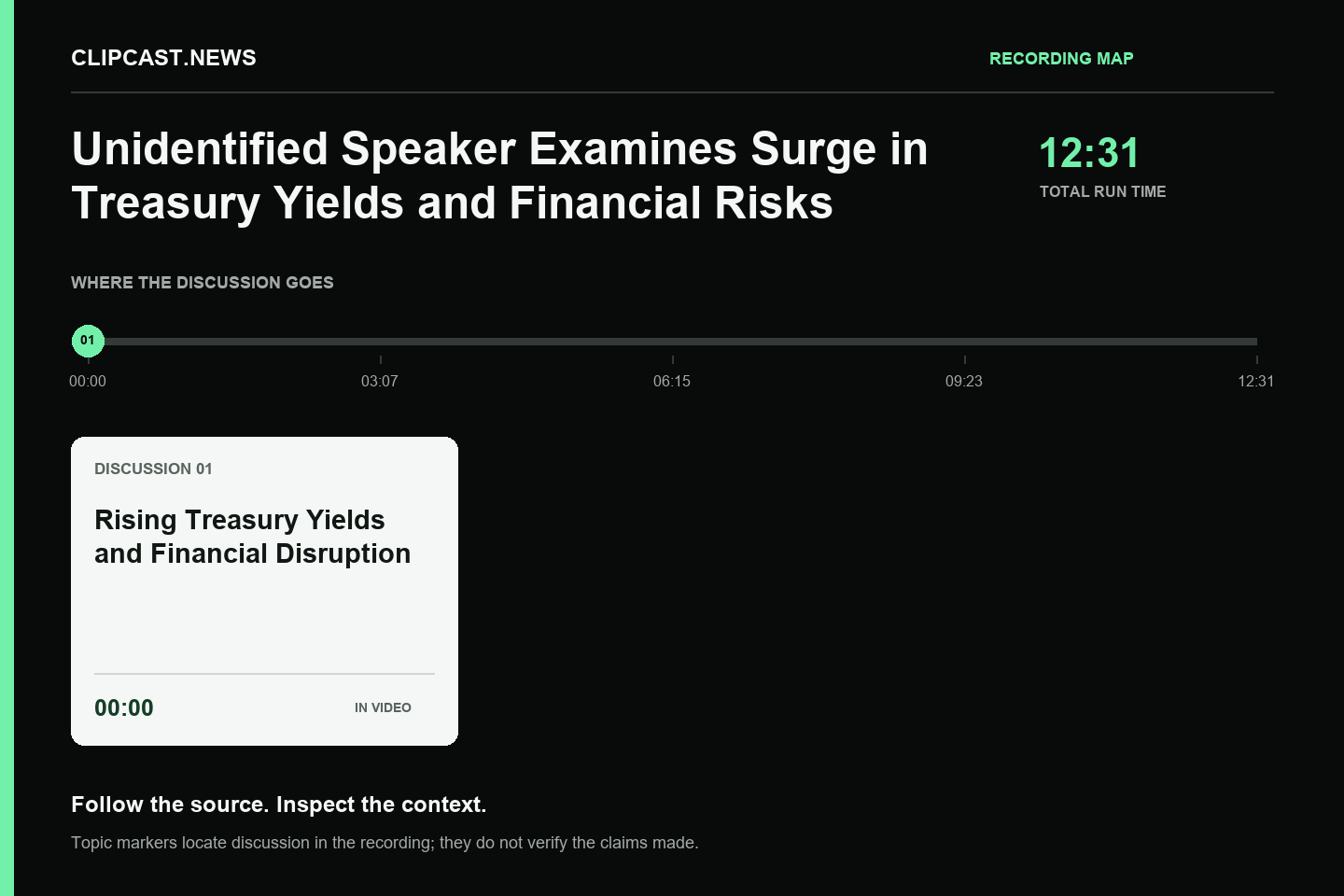
ClipCast.News recording map · timestamps derived from the original recording.
Beyond financial markets, the recording raises concerns about global food shortages due to fertilizer supply issues and the potential for a global depression if conflicts escalate, particularly with the threat of nuclear warfare. These factors, combined with the AI bubble burst, could lead to a severe economic collapse.
Findings apply to individual claims. “Opinion Based” can mean insufficient evidence and is not proof of truth or falsity. How we assess claims.
Opinion Based
The 10-year Treasury bond yield has surged to levels not seen since 2004, with the 30-year Treasury note reaching 5.444% and the 10-year nearing 5.15%.
External research is disabled for this recording. The source statement is not independently verified.
insufficient-evidence
Opinion Based
This rise is linked to the inverse relationship between bond prices and yields, where falling bond prices push yields higher.
External research is disabled for this recording. The source statement is not independently verified.
insufficient-evidence
Opinion Based
Analysts warn that such rapid increases in yields have historically preceded financial disruptions.
External research is disabled for this recording. The source statement is not independently verified.
opinion
Opinion Based
The yield on the 30-year Treasury note reached 5.444% this Wednesday, the highest level since 2004.
External research is disabled for this recording. The source statement is not independently verified.
insufficient-evidence
Opinion Based
The 10-year Treasury, that's the one that influences mortgage rates, briefly neared 5.15% on Thursday morning, a level it last reached in 2001.
External research is disabled for this recording. The source statement is not independently verified.
insufficient-evidence
Opinion Based
Experts suggest that the spike in Treasury yields is a baseline for borrowing costs, affecting credit card rates, loan rates, and mortgage rates.
External research is disabled for this recording. The source statement is not independently verified.
opinion
Opinion Based
The analyst mentioned in the recording noted that in the last five decades, 16 instances of rapid yield increases were followed by financial calamities, ranging from the 1987 stock market crash to the 2023 Silicon Valley Bank failure.
External research is disabled for this recording. The source statement is not independently verified.
opinion
Opinion Based
He looked at the last five decades of financial history.
External research is disabled for this recording. The source statement is not independently verified.
insufficient-evidence
Opinion Based
He found 16 different instances across this half century uh where treasury yields rose as fast as they are right now.
External research is disabled for this recording. The source statement is not independently verified.
insufficient-evidence
Opinion Based
During each and every one some sort of financial calamity uh resulted after that period.
External research is disabled for this recording. The source statement is not independently verified.
opinion
Opinion Based
The scale of the crises varied in their market impact from the jarring but short-lived Silicon Valley bank failure of 2023 to the 1987 stock market crash.
External research is disabled for this recording. The source statement is not independently verified.
insufficient-evidence
Opinion Based
The jump in yields almost always led to some sort of disruption of financial markets that weighed on risk assets.
External research is disabled for this recording. The source statement is not independently verified.
opinion
Opinion Based
The rise in yields is also tied to inflation and the Federal Reserve's interest rate hikes, which are intended to curb inflation but can exacerbate borrowing costs.
External research is disabled for this recording. The source statement is not independently verified.
insufficient-evidence
Opinion Based
The recording highlights that the 10-year Treasury yield is a critical indicator of economic health, with its fluctuations signaling potential economic downturns.
External research is disabled for this recording. The source statement is not independently verified.
insufficient-evidence
Opinion Based
The 10-year Treasury bond and their yields is the single most important factor in determining where the economy is going to go.
External research is disabled for this recording. The source statement is not independently verified.
opinion
Opinion Based
interest rates going up is problematic in a lot of ways.
External research is disabled for this recording. The source statement is not independently verified.
opinion
Opinion Based
The recording raises concerns about global food shortages due to fertilizer supply issues
External research is disabled for this recording. The source statement is not independently verified.
opinion
Opinion Based
the potential for a global depression if conflicts escalate, particularly with the threat of nuclear warfare
External research is disabled for this recording. The source statement is not independently verified.
opinion
Opinion Based
These factors, combined with the AI bubble burst, could lead to a severe economic collapse
External research is disabled for this recording. The source statement is not independently verified.
opinion
Opinion Based
fertilizer was also blocked from going through the straight of hormuz
External research is disabled for this recording. The source statement is not independently verified.
insufficient-evidence
Opinion Based
a lot of Asia did not plant rice this season. Why? Cuz they couldn't afford the fertilizer
External research is disabled for this recording. The source statement is not independently verified.
insufficient-evidence
Opinion Based
we will be having food shortages
External research is disabled for this recording. The source statement is not independently verified.
opinion
Opinion Based
prices spike even further
External research is disabled for this recording. The source statement is not independently verified.
opinion
Opinion Based
we're getting into a vicious cycle
External research is disabled for this recording. The source statement is not independently verified.
opinion
Opinion Based
it has already begun
External research is disabled for this recording. The source statement is not independently verified.
opinion
Opinion Based
we could even stop it
External research is disabled for this recording. The source statement is not independently verified.
opinion
Opinion Based
Even if we stop the war today, but if the war continues, it's a guaranteed collapse
External research is disabled for this recording. The source statement is not independently verified.
opinion
Opinion Based
Take it to the bank, write it down in stone
External research is disabled for this recording. The source statement is not independently verified.
 Cenk Uygur