Daniel Kolitz Says AI Displacement Led to Payday Loan Reliance
Daniel Kolitz describes how AI-driven automation displaced his freelance writing gigs, pushing him into reliance on payday loan apps with high interest rates and subscription fees. Kolitz's experience highlights the financial instability and emotional toll of AI-driven economic displacement, emphasizing the broader impact on white-collar workers.
Daniel Kolitz, a writer, describes how AI-driven automation displaced his freelance writing gigs, forcing him into reliance on payday loan apps. He notes that these apps, which offer short-term loans, often come with high interest rates and subscription fees, creating a cycle of financial instability. Kolitz's experience highlights the broader trend of AI's impact on white-collar work and the subsequent economic displacement.
Kolitz explains that payday loan apps operate by granting access to users' bank accounts, allowing them to withdraw funds quickly. However, many users are not approved for loans and instead pay subscription fees for access to the service. This model, which relies on high-interest loans and recurring charges, exacerbates financial strain for those already in precarious economic situations.
The payday loan industry, despite its controversial nature, is a billion-dollar business that thrives on financial instability. Kolitz notes that some companies, like Bridget, use nonrecourse advances to avoid regulatory scrutiny, further entrenching their power. This structure allows lenders to pursue borrowers aggressively, creating a cycle of debt that is difficult to escape.
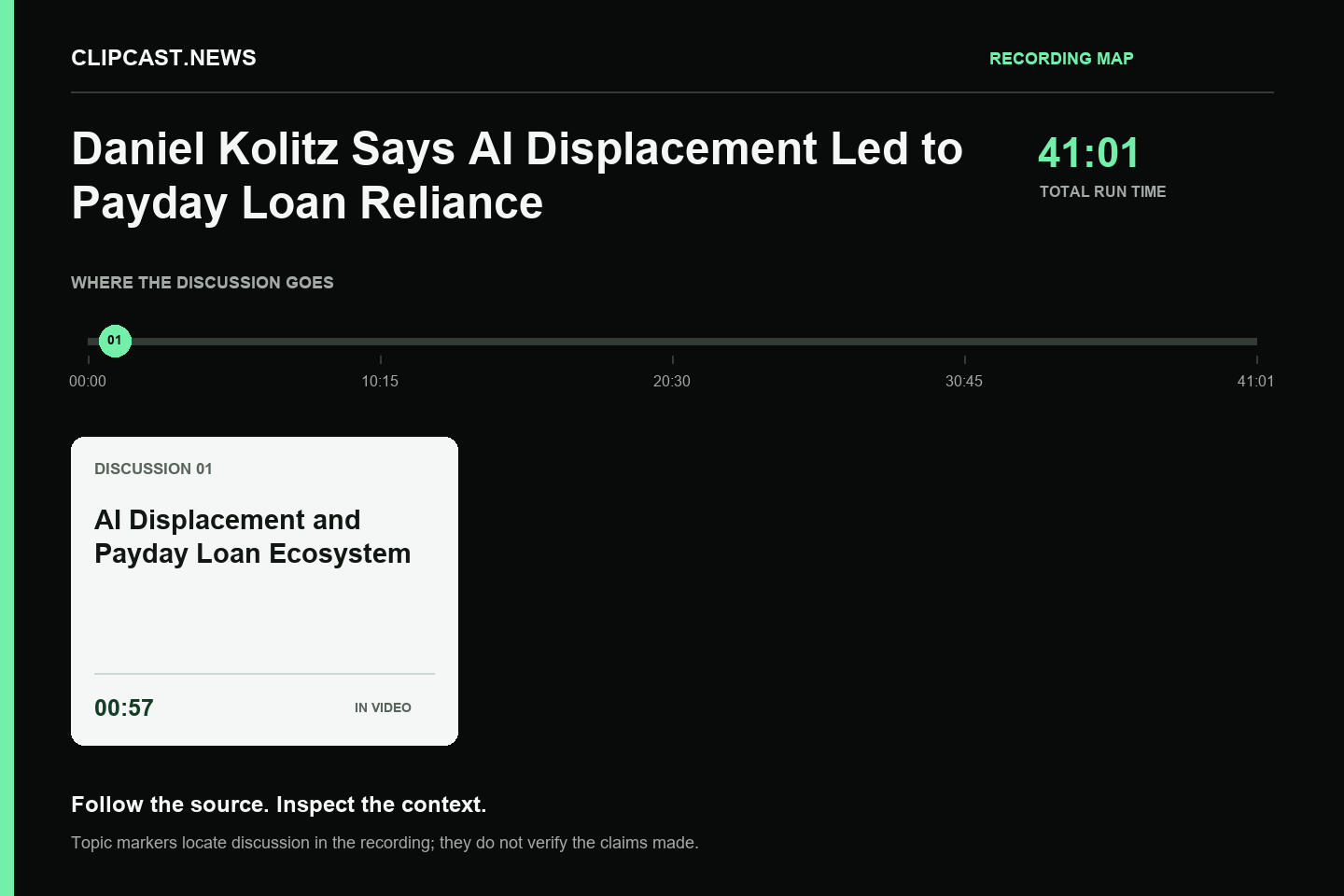
ClipCast.News recording map · timestamps derived from the original recording.
Kolitz's experience with payday loans underscores the emotional and psychological toll of financial instability. He describes feeling isolated and disconnected, relying on chatbots for interaction and using payday loan apps as a means to cope with personal and financial crises. This highlights the broader impact of AI-driven financial services on individuals' mental health and social connections.
Despite his initial struggles, Kolitz has managed to write his way out of the AI underclass, though he still pays subscription fees for payday loan apps. His story serves as a cautionary tale about the intersection of AI displacement and financial instability, emphasizing the need for systemic change to address the growing economic disparities exacerbated by technological advancement.
Findings apply to individual claims. “Opinion Based” can mean insufficient evidence and is not proof of truth or falsity. How we assess claims.
Opinion Based
Daniel Kolitz, a writer, describes how AI-driven automation displaced his freelance writing gigs, forcing him into reliance on payday loan apps.
External research is disabled for this recording. The source statement is not independently verified.
opinion
Opinion Based
He notes that these apps, which offer short-term loans, often come with high interest rates and subscription fees, creating a cycle of financial instability.
External research is disabled for this recording. The source statement is not independently verified.
opinion
Opinion Based
Kolitz's experience highlights the broader trend of AI's impact on white-collar work and the subsequent economic displacement.
External research is disabled for this recording. The source statement is not independently verified.
opinion
Opinion Based
Payday loan apps operate by granting access to users' bank accounts, allowing them to withdraw funds quickly.
External research is disabled for this recording. The source statement is not independently verified.
insufficient-evidence
Opinion Based
Many users are not approved for loans and instead pay subscription fees for access to the service.
External research is disabled for this recording. The source statement is not independently verified.
insufficient-evidence
Opinion Based
This model, which relies on high-interest loans and recurring charges, exacerbates financial strain for those already in precarious economic situations.
External research is disabled for this recording. The source statement is not independently verified.
insufficient-evidence
Opinion Based
The payday loan industry, despite its controversial nature, is a billion-dollar business that thrives on financial instability.
External research is disabled for this recording. The source statement is not independently verified.
insufficient-evidence
Opinion Based
Kolitz notes that some companies, like Bridget, use nonrecourse advances to avoid regulatory scrutiny, further entrenching their power.
External research is disabled for this recording. The source statement is not independently verified.
opinion
Opinion Based
This structure allows lenders to pursue borrowers aggressively, creating a cycle of debt that is difficult to escape.
External research is disabled for this recording. The source statement is not independently verified.
insufficient-evidence
Opinion Based
Kolitz's experience with payday loans underscores the emotional and psychological toll of financial instability.
External research is disabled for this recording. The source statement is not independently verified.
opinion
Opinion Based
He describes feeling isolated and disconnected, relying on chatbots for interaction and using payday loan apps as a means to cope with personal and financial crises.
External research is disabled for this recording. The source statement is not independently verified.
opinion
Opinion Based
This highlights the broader impact of AI-driven financial services on individuals' mental health and social connections.
External research is disabled for this recording. The source statement is not independently verified.
opinion
Opinion Based
The person that's they've economically been screwed by
External research is disabled for this recording. The source statement is not independently verified.
insufficient-evidence
Opinion Based
They're also incredibly lonely and have no human connection and the only sort of way they can communicate or feel a connection with anything is like chatting with the with the payday loan chatbot.
External research is disabled for this recording. The source statement is not independently verified.
opinion
Opinion Based
There are still Yeah.
External research is disabled for this recording. The source statement is not independently verified.
insufficient-evidence
Opinion Based
You know, real bottom of the barrel lenders.
External research is disabled for this recording. The source statement is not independently verified.
insufficient-evidence
Opinion Based
It's a kind of loan where they cannot like send it to a
External research is disabled for this recording. The source statement is not independently verified.
insufficient-evidence
Opinion Based
I don't owe the a uh payday loan apps any money.
External research is disabled for this recording. The source statement is not independently verified.
insufficient-evidence
Opinion Based
I do still pay subscription fees for all of them.
External research is disabled for this recording. The source statement is not independently verified.
insufficient-evidence
Opinion Based
I'm close. Uh, so I maintain I think it's like Albert. I'm done with Albert. No interest, but uh uh Dave, Cleo, uh
External research is disabled for this recording. The source statement is not independently verified.
insufficient-evidence
Opinion Based
You're cordial. >> Cordial. We haven't fallen out entirely.
External research is disabled for this recording. The source statement is not independently verified.
insufficient-evidence
Opinion Based
Kolitz has managed to write his way out of the AI underclass
External research is disabled for this recording. The source statement is not independently verified.
insufficient-evidence
Opinion Based
Kolitz still pays subscription fees for payday loan apps
External research is disabled for this recording. The source statement is not independently verified.
insufficient-evidence
Opinion Based
Kolitz's story serves as a cautionary tale about the intersection of AI displacement and financial instability
External research is disabled for this recording. The source statement is not independently verified.
opinion
Opinion Based
Kolitz's story emphasizes the need for systemic change to address the growing economic disparities exacerbated by technological advancement
External research is disabled for this recording. The source statement is not independently verified.
 Vox
Vox